30 days
A dated thirty-day plan
With workbook pages to hold your own numbers.
Michael Byrd's field guide for when the lights go out, the shelves go empty, and what happens next is up to you.
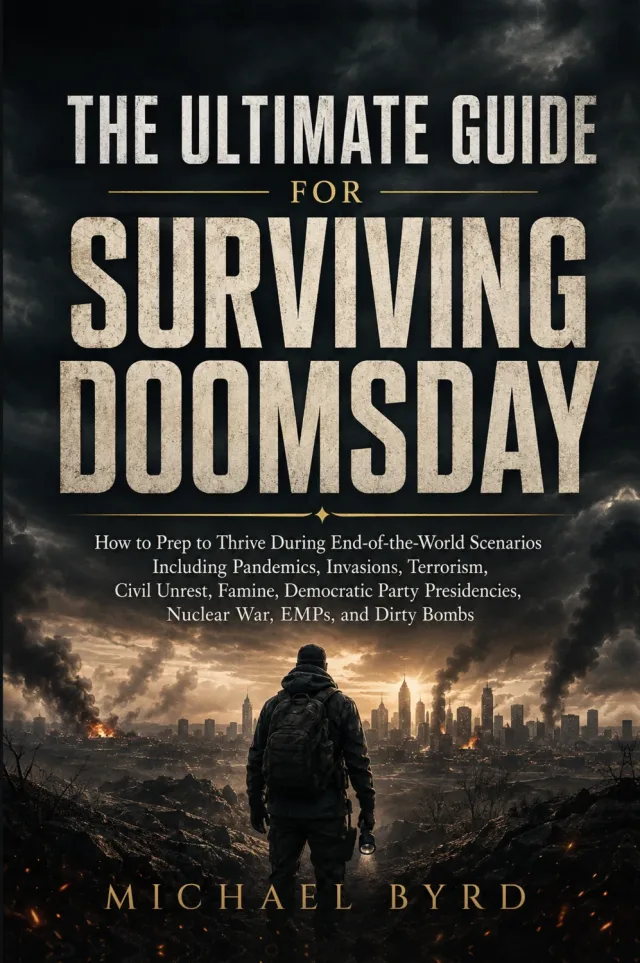
Page one of this book says the zombies catch and eat the slow, fat ones. It's a joke, and it isn't. Your town is one bad Tuesday and two missed meals from a place you wouldn't recognize.
The people who do fine there got ready while it was cheap. This book is the plan: gallons, watt-hours, calories and shielding, worked out so you can check every number yourself.
30 days
With workbook pages to hold your own numbers.
66 plates
Diagrams for the things words explain badly.
25 drills
Each one fits a Friday evening.
10 dilemmas
Decide now, while it is cheap to be wrong.
“You can have every philosophy in this book nailed down on paper and still fail if your head is not right. Survival is brutally mental.”
Free field tools for water, food, power and comms. They run in your browser, with no account and nothing to install.
Estimate an off-grid solar array and the battery bank behind it.
Assumes 80% solar system efficiency, a 20% array sizing margin, 90% inverter efficiency and 400 W panels. Seasonal production, surge loads and cold-weather performance need separate checks.
Solar array 1,100 watts, battery 8.9 kilowatt-hours.
Your system estimate
Start with measured loads. A refrigerator, well pump or air conditioner can draw several times its running power at startup.
How much to store, and how much bleach to treat it with.
Uses the bleach ratios from Chapter 23. Filter visibly dirty water first and use only fresh, plain, unscented bleach of the labeled strength. Bleach does not make chemically contaminated water safe.
Store 56 gallons. Bleach dose 40 drops.
Your water plan
Treat storage containers and a good filter as separate layers of the plan. Bleach formulation matters.
Turn family size and duration into a food-storage target you can measure.
The daily calorie figure is a planning assumption, not a personal metabolic estimate. Adjust for age, body size, workload, climate, dietary needs and waste, and plan protein, fat and micronutrients too.
303,600 calories needed, 33 percent stored.
Your ration target
Stockpile 33% of target
Rotate what you store and practice cooking it without the grid. Water and fuel are part of the food plan.
Encode a message and hear how it sounds on the air.
International Morse code. A slash marks word breaks in the visual output, and unsupported characters are left out. Playback uses your browser's audio.
Encoded signal
Learn to copy by ear and write important messages down. This is a training aid, not a transmitter.
Gear for the end of the world, or an ordinary Tuesday. Final designs and availability will be announced to the release list.
The slow ones get eaten.
Stay ready.
Thrive if you can.
The release date has not been announced yet. Join the release list on this page and you will get an email when the book is available.
Practical preparedness for pandemics, invasion, terrorism, civil unrest, famine, nuclear war, EMPs and dirty bombs. It includes a dated thirty-day plan with workbook pages, the math for water, food and solar power, sixty-six drawn plates, twenty-five dinner-table drills and ten hard dilemmas.
Michael Byrd is a retired engineer and lifelong prepper in the Rocky Mountains: Eagle Scout, thirty-five-year ham radio operator, beekeeper, builder, inventor and adjunct professor. He wired his own shop after reading the electrical code twice, and still got the panel wrong. He miscalculated his off-grid solar a dozen times before he got it right.
Plan on at least one gallon per person per day for drinking and basic hygiene. Three gallons per person per day is a more practical reserve. At the one-gallon minimum, a family of four needs 56 gallons for two weeks.
Use plain, unscented bleach. For clear water, add 8 drops per gallon of 6% bleach or 6 drops per gallon of 8.25% bleach, and double the dose for cloudy or cold water. Stir, wait 30 minutes, and check for a slight chlorine smell. If there is none, repeat the dose and wait 15 more minutes. Bleach does not remove chemical or radioactive contamination.
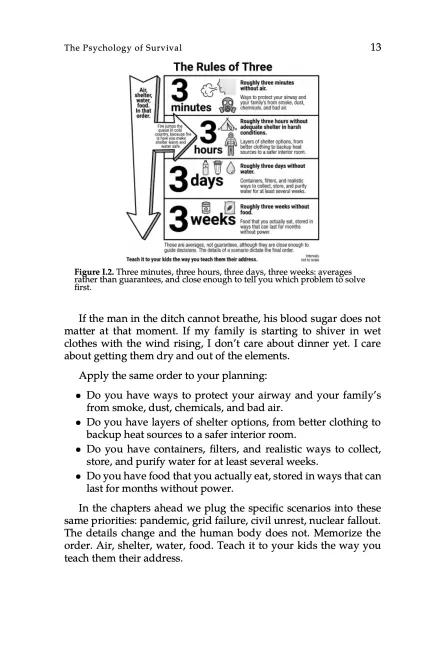
Yes. The chapter "The Psychology of Survival" is free to read on this site as seven original book pages, and you can download it as a PDF.
Get one email when The Ultimate Guide for Surviving Doomsday is released.